Robert Reich recently posted an article on Salon about why we should not worry about the US government debt, and why it should be even higher that it is now. Government spending, he says, got us out of the Great Depression, and it can get us out of the current recession. Reich’s dad though that it would take 60 years to pay of Roosevelt’s debt, and it only took 20, so why are we worried now? Here is a graph that illustrates Mr. Reich’s point: 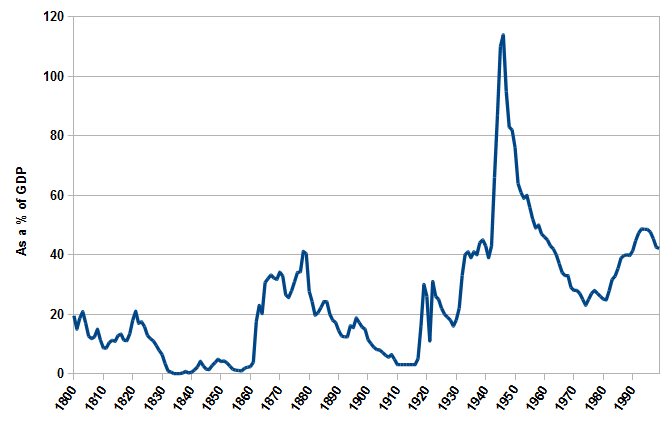 As Reich claims, the debt was higher in the 40’s, as a percentage of GDP, and it was paid off ( to a pre-war level ) in about 20 years. I’m still worried. We don’t know what the next 20 years will bring. If those years are as prosperous as 1945 to 1965, a larger debt, and associated spending, may be a net benefit to our economy, but there is a deeper problem. Here is a graph from the GAO report A Citizen’s Guide to the 2008 Financial Report of the U.S. Government that shows the sum of the US Government’s expenses, from 1970 to 2080:
Trying Out Google and Facebook Friend Connect
Would you be my Friend? Here is Google’s Friend Connect Widget:
var skin = {}; skin[‘BORDER_COLOR’] = ‘#cccccc’; skin[‘ENDCAP_BG_COLOR’] = ‘#e0ecff’; skin[‘ENDCAP_TEXT_COLOR’] = ‘#333333’; skin[‘ENDCAP_LINK_COLOR’] = ‘#0000cc’; skin[‘ALTERNATE_BG_COLOR’] = ‘#ffffff’; skin[‘CONTENT_BG_COLOR’] = ‘#ffffff’; skin[‘CONTENT_LINK_COLOR’] = ‘#0000cc’; skin[‘CONTENT_TEXT_COLOR’] = ‘#333333’; skin[‘CONTENT_SECONDARY_LINK_COLOR’] = ‘#7777cc’; skin[‘CONTENT_SECONDARY_TEXT_COLOR’] = ‘#666666’; skin[‘CONTENT_HEADLINE_COLOR’] = ‘#333333’; skin[‘NUMBER_ROWS’] = ‘5’; google.friendconnect.container.setParentUrl(’/’ /* location of rpc_relay.html and canvas.html */); google.friendconnect.container.renderMembersGadget( { id: ‘div-4019134814077193782’, site: ‘18179748395891449876’ }, skin); And Here is Facebook’s. Facebook requires a lot more work, because you have to program in XFBML Your picture, if you are logged into facebook: Here are a bunch of your friends:
Cheaper Recyclables Collections
Interested in doing a science project, Max and I went to the alley to collect a 2 liter plastic bottle from the recyclables bin. I had put the bottle in the bin the day before but could not find it that day. I also noticed the beer and wine bottles were missing, but the paper and cardboard were still there. The common factor in the missing items was the California Redemption Value tax, and the next day the mystery was completely solved, when I saw two people in the alley collecting bottles from the bins. The California Redemption Value (CRV) like other deposit charges, and the Oregon Bottle Bill that preceded it, were largely intended to decrease roadside trash and increase recycling rates. They are very effective because of the economic principle that people respond to incentives. If there is enough of a benefit to either not throwing a bottle away, or picking it up after it has been discarded, the bottle will not end up in the trash or the roadside. The same thing happens on the beach, where bathers will intentionally leave aluminum cans behind because they know someone will pick them up. These deposit charges are a classic market solution, and are an excellent way for the government to shape society. Rather than trying to jail or fine people who litter, governments can use financial incentives to encourage the desired behavior. This mechanism is also know as “internalizing negative externalities” or a Pigovian Tax. The incentive works, and it works very well. I doubt that the recycling collection on my street gets anything except paper. I’d expect that this effect results in the recycling program being lees financially viable, since people are removing the most valuable recyclables from the program and claiming the CRV and recycling value for themselves. We could get upset about this, and make trash picking illegal, or we could use the effect to make recycling programs more effective. One possible improvement would be to add a redemption value for all recyclables and replace recycling bins with low, wide bins that make it easier for trash pickers to remove items, which would allow governments to eliminate collection of recyclables. This scheme would require adding the CRV to all recyclable containers, which would raise the price of many products, making it politically unpopular, and many progressives would oppose the plan because it encourages the poor to take on a low wage job. But despite these hurdles, employing incentives is one of the most powerful ways for governments to encourage socially valuable behavior.
The Evil of Denying Claims
 A common argument against the current state of American health care is that the evil insurance companies make their obscene profits by denying claims. I don’t intend to tackle the question of the moral right of companies to make profits, or to defend the current state of American health care, but I do want to address the moral and economic issues of health care companies denying claims. One of the important implications of the law of supply and demand is that when the price of something drops, demand increases, and if the price is zero, people will probably demand more than there is supply of the thing. If the thing is plentiful, like air, there isn’t much problem. For for everything else, a price of zero usually means lines, shortages or rationing. Imagine anytime a company like Starbucks or McDonalds gives it’s products away: the offer generates a crowd, and all the free stuff is gone before you get there, so you don’t get any. A second important economic principle is that “people think on the margins.” This means that most economic decisions are based on the price of one more thing, not the price of the things you already have. If you have already had an ice cream cone, you probably won’t want to pay $2 for another one. But if the price is free, you will probably take it. You decision is based on the fact that the next cone is free, not that the average price for both cones is $1. When most people get health insurance, they pay a fixed price up front, or have their employers pay that cost, and the cost of any of the procedures after that is small. The real cost of going to the doctor one more time may be $200 per visit, but with health insurance, that marginal cost is $20. The same thing is true for most other procedures. This means that regardless of what the average cost of a procedure is to a person, the marginal cost is very low relative to the actual cost. So, we have a low marginal cost, and that means that people are going to demand more of it. If going to the doctor for a cold cost me $200, I would only go if I am really sick. But for $20, I’ll go just to find out what I’ve got. Thus the low marginal cost results in a higher demand. Since people naturally want to stay healthy, they will demand to get more health care than they have actually paid for. Since the health care company cannot rely on price to regulate demand, they have to rely on an administrative procedure, which takes the form of denying claims. If they didn’t deny any claims, everyone would spend more than they paid, and the insurance company have cost overruns, possibly going broke. The NHS may already be in this situation. That’s not a criticism of the NHS, just a sign of the natural desire for everyone to get more (service) and pay less (taxes). If the US had a single-payer system like the NHS, the marginal cost of health care would drop even more; it would be marginally free to everyone, so the demand would increase even more. A single payer health care system would have to deny even more claims than the system we have now. That alternate system could be an improvement over the system we have now, but we should expect that the number of claims it will have to deny would actually increase. So, the general act of denying claims is not an evil; it is a necessary component of any system where the marginal cost of care is less than the actual cost. What is evil is when a health care provider denies a claim that they have agreed to pay as part of the contract with the insured. This case, however is a matter of contract law, and if it were widespread, it would be handled very effectively through class-action lawsuits. ( Image from Solid Threads. Please visit them so they don’t sue me for stealing their image. )
Daily Mail Sucked In By Science Hoax
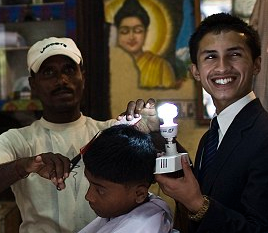 There is always someone who will believe an incredible science or technology story, especially when the technology could save the planet, or is invented by a teen-ager, or comes from the third world. When the story has all three elements, the suckers get in line. Today, the Daily Mail reports that an Indian teen-ager has created an inexpensive solar cell from human hair. It is an inspiring story about a plucky teen who will one day change the world. The only way for it to be a better story would be for it to be true. I’d be happy if it just were not jibberish. As with many hoaxes, there is an element of truth. Melanin, a component of dark human hair, is a semiconductor and is photo-reactive, and you can use it to create a solar cell. However, these cells, like most solar cells made from organic semiconductors, are not very efficient, about 2.7%. Unless the cell is virtually free, 2.7% is not going to change the world. So, it is possible to do, and it has been know to be possible for about 40 years, but it isn’t economically feasible. Also, it isn’t very easy to do. You have to extract the melanin from the hair (pdf) into a solution or a substrate, and one of the electrodes is copper wire coated with silicon. What is certain not to work is to string the hair along thumbtacks on a board, which is what it appears the intrepid teenager did. The probable problems with this arrangement are numerous:
The Received Wisdoms Of Venture Capitalists
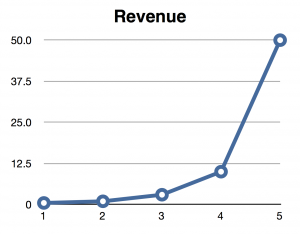 The substrate of the start up business plan is that the nascent business will reach $50 million revenues per year after 5 years. Venture Capitalists seem to expect that every pitch will have a revenue graph with a hockey-stick shaped revenue line that shows the business at $50M in 5 years. Naturally, this means that constructing a financial model for a startup involves tweaking the spreadsheet to get $50M in 5 years. All of the other predictions of the model are secondary. When have we asked if this is a reasonable goal? Are any Entrepreneurs bold enough to ask VC how many of their portfolio companies have actually his $50M in 5 years? Fortunately, Christian Chalbot of IPO Dashboards has done some analysis to determine how long it takes technology startups to reach $50M. His answer is about 8 years, but that value is determined from studying the top 100 technology companies in the US, ranked by revenue. The number is certainly a gross underestimate, because it doesn’t include any of the companies that did not IPO, failed, or were not in the top 100. In short, even among the most successful US companies, it still takes and average of 8 years to reach $50M in revenue. So, Entrepreneur, next time you are showing your hockey-stick graph, what you are really saying is: “My company will be more successful that Microsoft, Adobe or Novell. " Really, why should anyone believe you? Today, Techcrunch summarizes additional proof that, despite the popular image of the scrappy young entrepreneur, most entrepreneurial activity, and the most successful startups, is run by grey-hairs. This report from the Kaufmann Foundation puts Techcrunch’s hunches to numbers.
Hating The Creators
 In his Labor Day article in Salon.com, Michael Lind satirizes free-market conservatives, who he claims believe that Laborers destroy wealth. In building that thesis, he presents a range of logical fallacies that are interesting to analyze. Mr. Lind doesn’t daly. His opening sentence lays out his theme:
Today is Labor Day, when we celebrate the wealth destroyers – at least if the libertarian right is to be believed.
I’ve never hear such a ridiculous idea — that laborers destroy wealth — expressed by any libertarian, in words nor in print. How did Lind come to think that this idea is typical of the libertarian right? Maybe he is just being dramatic, as his second sentence moderates a bit:
I Stole Clooney's Hair
With a lot of help from the InStyle Makeover, I stole George Clooney’s hair. I don’t think it helped:  I think I’d trust Bald Eric or Hat Eric much more than Clooney Hair Eric.
The Perfect Evening
The Perfect 5:00:
 |
The Perfect 5:45:
 |
|---|
Child Sacrifice, For Children Who Love Freedom
Mummification, human vivisection and live burials in a format children can understand. Yes, really. You Wouldn’t Want to Be an Inca Mummy will let parents address most of the uncomfortable questions that don’t involve sex, including human sacrifice, what happens when you yank out someone’s heart, the various ways of clubbing someone to death, and how the commoners should prostrate themselves before their rulers. The authors certainly aren’t operating under a belief in the concept of the Noble Savage. And, it has a cartoonish format and simple text that is suitable for first and second graders. While the book really is disturbing (and disturbing for someone who used to read alt.tasteless on Usenet ), and I’m still not sure when I’d read it with Max, that I’d find this prominently displayed on the “New Books” shelf in the children’s section of the library absolutely thrills me. When the media seems to be failing in its critical role as defenders of open, free expression, we still have librarians who will fight to put whatever they damn well want to on the shelves. Here is another example. F’d Companies is the most profane, nearly obscene, book I’d ever admit to reading, but it is also an important chronicle of the insanity of the late 1990’s. I nearly howled with joy when I saw it on a public library shelf. I could imagine the librarian placing it facing outward, thinking to herself that it would be a poke in the eye of every sanctimonious prude that passed by. God bless her.  Don’t forget, kids, child sacrifice is a privilege.
